








By: Er. Ankur Kaushik
International Export Manager– Yes Group of Minerals
Diploma in Ceramic Technology | B.Tech (Ceramics) | MBA (International Business
In the realm of modern construction and interior aesthetics, the ceramic industry stands as a monumental pillar—an industry that fuses art with science, and form with function. Among its sub sectors, the Tiles and sanitary Ware Industries have witnessed unprecedented growth driven by global urbanization, evolving consumer preferences, and the pursuit of hygienic, durable, and aesthetic solutions. Yet, at the heart of this sophisticated industry lies a humble but mighty foundation—Ceramic RawMaterials.
As a Ceramic Technologist with years of experience across global markets, I have had the opportunity to witness and study the pivotal role of raw materials in defining product quality, manufacturing efficiency, cost dynamics, and sustainability trajectories. This article delves into the use, benefits, and scope of Ceramic Raw Materials, while also shedding light on the emerging frontier of waste utilization—a critical leap toward circular economy and environmental responsibility.
From the Earth to the Globe
In a world racing toward rapid urbanization, digital architecture, and sustainable infrastructure, one material has stood resilient and transformative—ceramics. Behind every polished tile, every hygienic sanitaryware unit, every digitally printed surface, lies a meticulously engineered mix of ceramic raw materials.
But as markets globalize and technologies evolve, the source of ceramic power is shifting—from nations with surplus to nations with scarcity, from commodity supply to strategic export. In this article, I unfold a deep analysis of the current global scenario, the export potential of ceramic raw materials, and the emerging demand from various world regions.
Ceramic Raw Materials: The Strategic Industrial Backbone
The primary raw materials used in ceramic tile and sanitaryware production include
Kaolin (China Clay)
A hydrous aluminosilicate, kaolin provides plasticity during shaping and acts as a binder. Its purity and whiteness define the brightness and translucency of final products.
Ball Clay
Known for its plasticity, ball clay improves workability in shaping operations and contributes to the mechanical strength of green (unfired) bodies.
Feldspar
A fluxing agent, feldspar lowers the vitrification temperature, enabling energy savings and improved product strength.
Quartz (Silica)
Provides rigidity, controls shrinkage during firing, and boosts mechanical strength.
Dolomite, Talc, Bentonite, and Other Additives
Used as fluxes or property modifiers, these enhance thermal behavior, glaze compatibility, or mechanical performance.
Ceramic raw materials are no longer viewed merely as mined commodities—they are now engineered minerals designed for specific purposes in tiles, sanitaryware, tableware, insulators, refractories, and advanced ceramics.

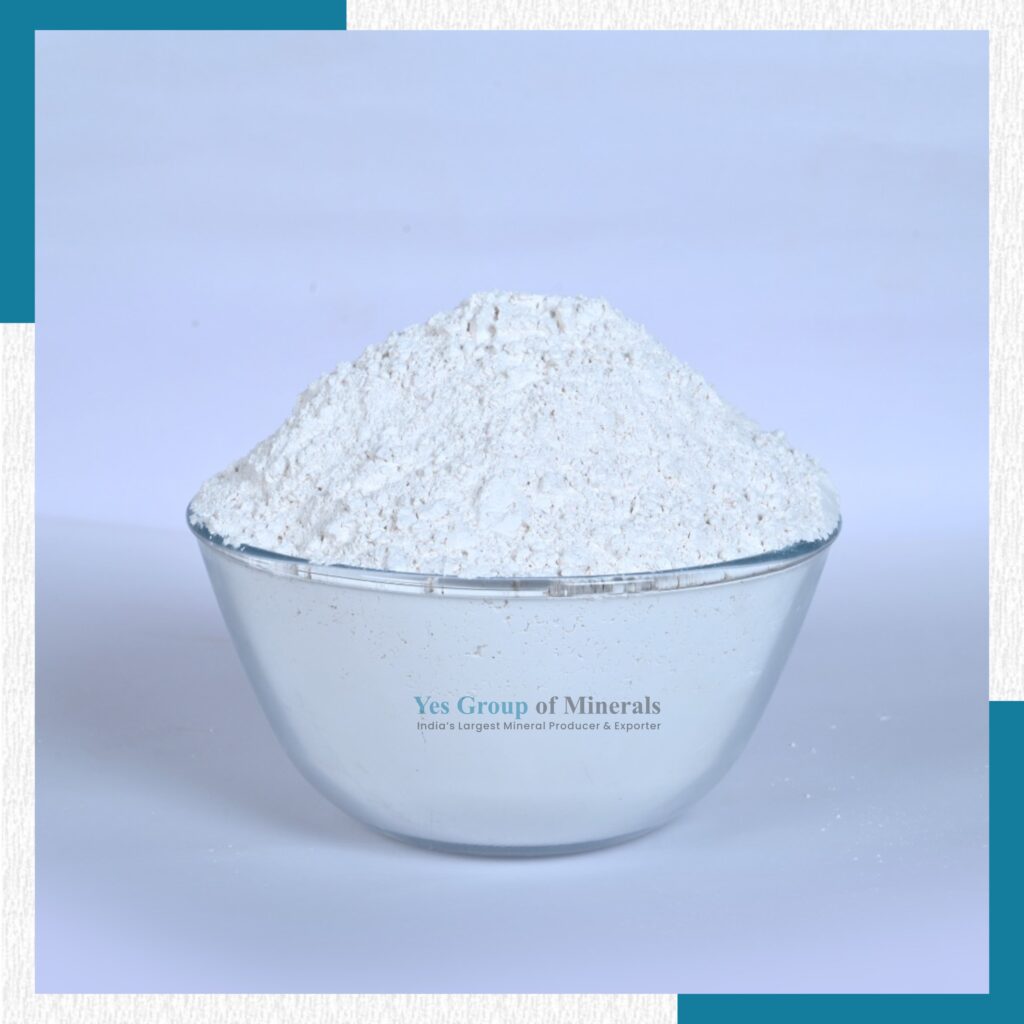
Key Materials and Their Role:
| Role in Ceramics | Critical Properties | Applications | |
| Material Kaolin (China Clay) | Binder, Refractory Agent | High Al₂O₃, Whiteness, Plasticity | Sanitaryware, Glazed Tiles |
| Ball Clay | Plasticity Enhancer | Fineness, Binding Power | Vitrified Tiles, Pressure Casting |
| Feldspar | Flux (Melting Agent) | Low Melting Point, Alkali Content | Wall & Floor Tiles, Porcelain |
| Quartz (Silica) | Strength & Stability | Thermal Resistance, Rigidity | Floor Tiles, High Temp Wares |
| Zircon | Opacifier & Abrasion Resistance | Brightness, Whiteness | Digital Glazes, Sanitaryware |
| Bentonite | Rheological Agent | Water Absorption, Gel Strength | Slip Casting, Body Reinforcement |
These materials undergo rigorous beneficiation, blending, and grinding before they are transformed into ceramic bodies suitable for pressing, casting, or extrusion.
Benefits of Ceramic Raw Materials in Tiles and Sanitaryware
Enhanced Mechanical Strength
The synergistic interaction between kaolin, feldspar, and silica leads to superior modulus of rupture (MOR) in tiles and high-impact resistance in sanitarywares.
Dimensional Stability & Low Water Absorption
With optimal fluxing and vitrification, tiles achieve low porosity and high density, making them suitable for indoor, outdoor, and wet applications.
Surface Smoothness and Glaze Fit
High-purity raw materials ensure surface regularity, which is crucial for glaze application and adhesion, enhancing both beauty and durability.
Thermal and Chemical Resistance
Especially important for sanitaryware that comes into contact with hot water and aggressive cleaning agents.
Environmental and Hygienic Advantages
Naturally inert and non-toxic, ceramic bodies made from high-quality raw materials support better hygiene, stain resistance, and are allergen-free.
Customization and Innovation
Fine-tuning the raw material blend allows manufacturers to create products ranging from glossy vitrified tiles to matte rustic finishes and ultra-thin large-format tiles
Technological Advancement & Material Engineering
The role of raw materials is no longer passive. With the rise of material engineering and digitalization, manufacturers are experimenting with:
- Nano-enhanced ceramic bodies
- Low-temperature sintering fluxes for energy efficiency
- High-alumina sanitaryware blends for superior whiteness and strength
- Additive manufacturing (3D printing) of sanitary components using refined slurries
These innovations start at the very root—the choice and processing of raw materials.
Global Scope and Export Potential of Ceramic Raw Materials
India, being a mineral-rich country, especially in regions like Rajasthan, Gujarat, and Andhra Pradesh, is now the hub of premium ceramic raw materials. Companies like Yes Group of Minerals are spearheading this export revolution by offering:
High-alumina kaolin for vitrified tiles and sanitaryware
Ultra-white ball clay for export-grade ceramics
Soda and potash feldspar with low iron content
Custom blends tailored to the needs of global manufacturers
With strategic alliances, advanced beneficiation plants, and stringent quality control, Indian ceramic raw materials are now recognized in over 30+ countries across Asia, Africa, Europe, and South America.
Current Scenario of Ceramic Raw Materials: Global Overview
Market Landscape:
- India, Brazil, Ukraine, and Turkey continue to dominate in reserves and mining of kaolin, feldspar, and ball clay
- China, once the leader in ceramic raw exports, has tightened its supply chain due to resource conservation policies and energy restrictions.
- Europe, despite its technological superiority, is increasingly turning to imports due to high mining costs and environmental constraints.
- ASEAN nations, especially Vietnam, Indonesia, and Bangladesh, are expanding ceramic manufacturing but are dependent on imports for high-grade raw materials.
Industry Drivers:
Global construction boom (housing, infrastructure, commercial spaces).
Rise of digitally printed vitrified tiles and large-format slabs requiring superior mineral performance.
Sustainability mandates leading to optimized firing cycles and low-emission materials
Shift toward pressure casting and automation in sanitaryware manufacturing.
Export Scope: India as the Epicenter of Global Ceramic Supply
WhyIndia?
- Abundant and diverse reserves of kaolin, feldspar, quartz, bentonite, and zircon substitutes.
- Low-cost mining and processing compared to Western markets.
- Skilled manpower and government incentives under ‘Make in India’ and PLI schemes.
- Proximity to major export destinations via Mundra, Kandla, Vizag, and Chennai ports.
India’s Export Potential Segments:
Tiles & Sanitaryware Manufacturing Hubs in: Middle East (UAE, Oman, Saudi Arabia), Africa (Morocco, Egypt, Nigeria), Southeast Asia (Vietnam, Philippines, Bangladesh)
European Buyers sourcing engineered mineral mixes for specialized ceramics.
South America importing for both construction ceramics and electrical insulators.
Sustainability & Waste Utilization: A New Industrial Mandate
As the world pivots towards green manufacturing, the ceramic industry is embracing waste utilization in unprecedented ways.
Recycling of Fired Waste (Scrap Tiles and Sanitaryware)
Ground into grog or chamotte, fired ceramic waste can be reintroduced into the body formulation for non-structural parts, reducing raw material consumption.
Utilization of Processing Waste
Sludge from ball mills, filter press cakes, and glaze overflows can be dried and re-used, lowering both waste output and energy costs.
Use of Industrial By-products
Materials such as fly ash, red mud, granite cutting waste, and glass cullet are now being blended with traditional ceramic raw materials to create eco-tiles and value-added products.
Circular Design Principles
Modern tile plants now integrate waste heat recovery, closed-loop water systems, and zero-waste discharge policies, supported by mineral designs that facilitate these systems.
Conclusion: The Future Is Ceramic, The Foundation Is Mineral
The demand for ceramic tiles and sanitaryware is set to grow exponentially with the rise in housing, infrastructure, and smart cities. However, the true enabler of this growth lies beneath our feet—in the natural and engineered ceramic raw materials.
As manufacturers, researchers, and technocrats, our responsibility is twofold:
To optimize the use of natural resources through precision mining, beneficiation, and efficient material usage.
To innovate towards zero-waste and circular economy models, where even the waste of yesterday becomes the input of tomorrow.
From Earth to Excellence
The ceramic industry is at the cusp of a global shift, and ceramic raw materials are no longer just the base—they are the brain and backbone of the ceramic value chain. The world is looking for consistent, engineered, sustainable, and technically superior materials. India, with its rich geology and evolving mineral intelligence, is best positioned to fulfill that need.
As a technocrat, strategist, and global ambassador for India’s mineral potential, I believe that with the right export strategy, technical precision, and global vision, we can turn every ton of ceramic raw material into a symbol of Indian innovation and global trust.
At Yes Group of Minerals, we are committed to this vision—combining technological leadership with global supply capabilities and sustainable practices. The ceramic world of tomorrow will be built not just with tiles and sanitaryware, but with ideas, minerals, and conscience.
“We don’t just export minerals. We export ceramic solutions engineered for global production excellence.”
– Er. Ankur Kaushik
About the Author
Er. Ankur Kaushik is a Ceramic Technologist and International Export Manager at Yes Group of Minerals. With a Diploma and B.Tech in Ceramic Technology and an MBA in International Business, he brings a unique blend of technical expertise and global market insight. Ankur is a passionate advocate for sustainable ceramics and has represented Indian minerals at multiple global expos and forums.